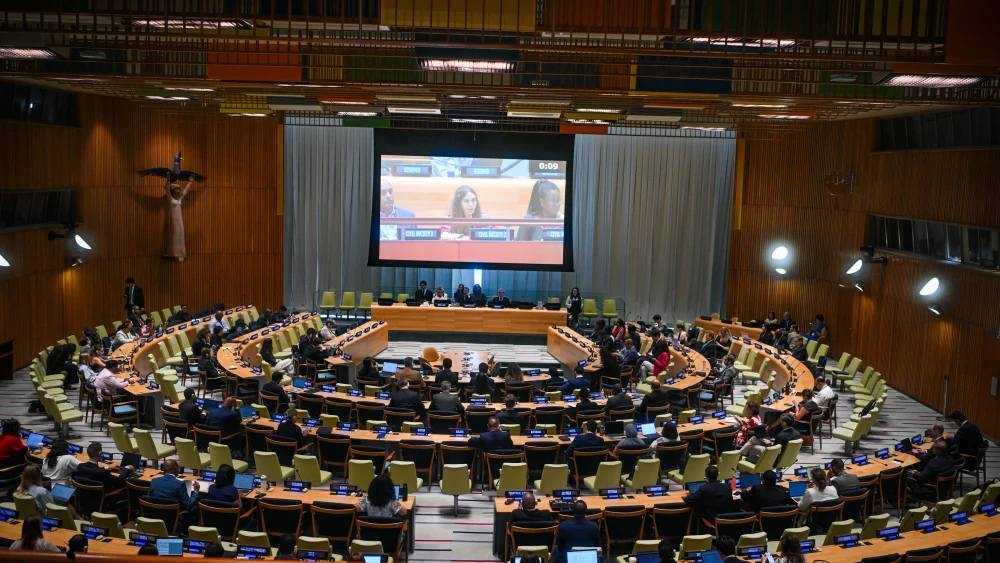

It is open season on Israel at the United Nations General Assembly. Nothing very new there.
The atmosphere, as we await Israeli Prime Minister Benjamin Netanyahu’s address on Thursday, has already been set by New York Mayor Zohran Mamdani. In a city once known as perhaps the most Jewish in the world, Mamdani has again declared that he considers Netanyahu a war criminal. It is a pity that U.S. President Donald Trump, standing beside him, did not respond.
But the prize for the most original falsehood goes to French President Emmanuel Macron, followed by the more familiar accusations from Turkish President Recep Tayyip Erdogan, Jordan’s King Abdullah II, Brazilian President Luiz Inácio Lula da Silva and U.N. Secretary-General António Guterres, for whom the Oct. 7 massacre “did not happen in a vacuum.”
Now there is a newcomer: Syrian President Ahmed al-Sharaa, the former jihadist leader whose organization was once affiliated with Al-Qaeda.
Trump, in his own distinctive way, had compared the massacres of Sept. 11, 2001, and Oct. 7, 2023. But then pre-election politics, with the U.S. midterms approaching, took center stage.
Netanyahu’s office responded to the attacks with a video describing them as “a chorus of parrots.”
But there is more to it than that.
Attacking Israel is a useful political card for leaders facing troubles of their own: Macron in France; Abdullah in Jordan; and Erdogan, the would-be sultan and friend of Hamas.
The accusations grow ever more extreme: genocide, ethnic cleansing, occupation, evil settlers, supremacists and now “messianists.” The language changes, but the target remains the same.
The reality in Judea and Samaria
Macron was “grotesque,” as Netanyahu put it, when he portrayed Israel as attacking Judea and Samaria while suggesting that Hamas barely exists there.
But while world leaders delivered their speeches in New York, another young Israeli was fighting for his life after a Palestinian terrorist rammed his car into the Maccabim checkpoint in Samaria on Wednesday.
Neria Leiter, the son of Israeli Ambassador to the United States Yechiel Leiter, was seriously wounded in the attack. Doctors at Jerusalem’s Shaare Zedek Medical Center were fighting to save his life.
“Neria needs a miracle,” his father wrote, appealing for prayers.
The tragedy facing the Leiter family is especially cruel. Neria’s older brother, Maj. Moshe Leiter, was killed fighting in Gaza in 2023. Neria nevertheless continued to serve, completing hundreds of days of reserve duty on multiple fronts since Oct. 7.
A day before, another Israeli father, Netanel Shukrun, was murdered in a terrorist attack in Samaria.
“It is a pity,” says Col. Richard Hirsh, a Palestinian affairs expert at the Jerusalem Center for Security and Foreign Affairs, “that just one day earlier Hamas had carried out yet another murder, killing Netanel Shukrun in the street.”
Shukrun left behind six children, aged 3 to 15. As he was dying, he shouted to his son to run.
“Thousands of attacks have emerged from Judea and Samaria, including hundreds of suicide terrorists from Jenin, Bethlehem and Hebron,” Hirsh said. “And today they are preparing new attacks and teaching their children to aspire to shahada. We can keep this under control only by intervening.”
The record is long and bloody.
Hirsh recalls the Dolphinarium suicide bombing and the Park Hotel massacre, as well as the three Israeli teenagers kidnapped and murdered in Gush Etzion in 2014 and the murder of Rabbi Eitam and Naama Henkin in front of their children.
Support for the Oct. 7 massacre remains widespread among Palestinians in Judea and Samaria. Hamas would pose a serious challenge to Palestinian Authority leader Mahmoud Abbas’s Fatah faction if elections were held—one reason Palestinian elections have not taken place for years.
A familiar chorus
The other speakers at the United Nations are no better.
Erdogan turns the accusation of Nazism against Israel in a tornado of words. Guterres now speaks of “ethnic cleansing” in the West Bank as well as Gaza.
Al-Sharaa, who not long ago was speaking about the Abraham Accords, now mocks Trump’s recognition of Israeli sovereignty over the Golan Heights, suggesting that he might as well have given Israel New Jersey.
He forgets why the Golan matters.
The heights overlook the Galilee, the Hula Valley and the Sea of Galilee. Before Israel captured the territory in the 1967 Six-Day War, Syrian forces used the commanding heights to shell Israeli communities below.
And King Abdullah II, whose kingdom Israel has repeatedly helped to protect, accuses Israel of expansionism while confronting a question that has haunted the Hashemite monarchy for decades: the relationship between Jordan and the Palestinian national movement.
Hirsh goes further. “Jordan is the real Palestine,” he says, pointing to the kingdom’s majority-Palestinian population and arguing that Israel should not be expected to create another Palestinian state in Judea and Samaria.
Now Netanyahu will answer an impossible demand—the demand that Jews justify their very existence and their determination to resist a continuing threat.
Meanwhile, Trump is talking with Iran and the Gulf states, and the politics of oil, security and regional power are again in motion.
Far from the speeches and accusations at the United Nations, and beyond the coming elections, the Middle East is being reshaped again.
Israel is not merely fighting for its own survival. It is seeking a real peace—one grounded in security, democracy and the rejection of terrorism—while standing on the front line of a struggle that concerns the entire free world.
The real question is whether that world understands that Israel’s fight is also its own.